
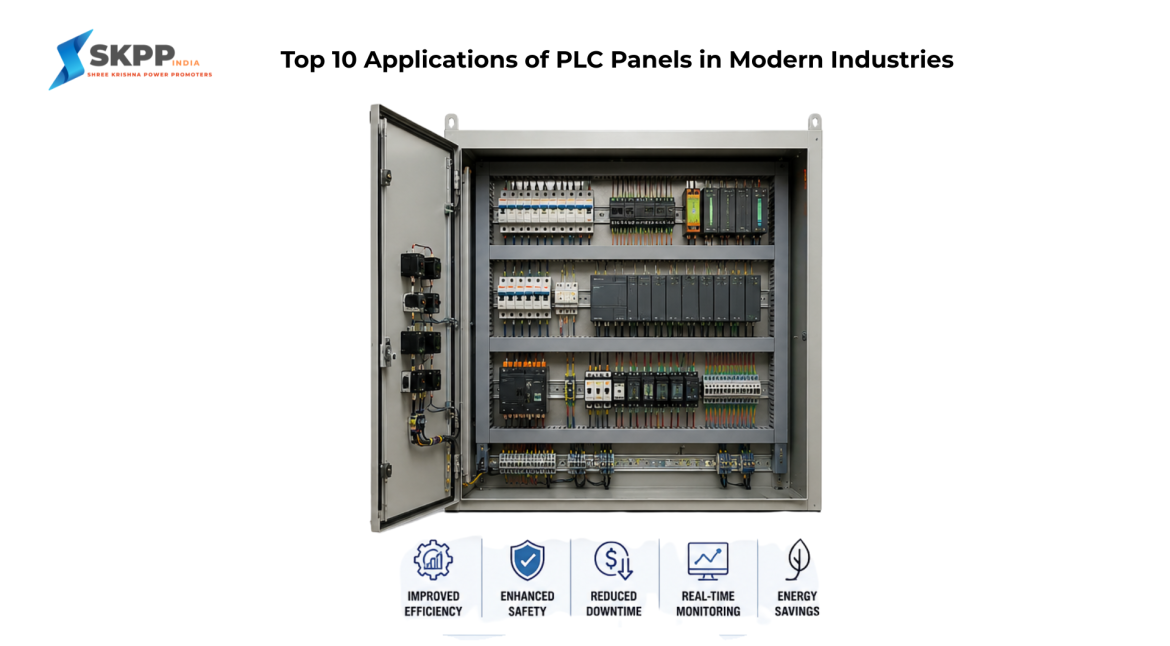
In today’s fast-moving industrial world, automation has become essential for improving productivity, reducing human errors, and maintaining operational efficiency. One of the most important technologies behind industrial automation is the PLC panel. A PLC panel, also known as a Programmable Logic Controller panel, is used to control and automate machinery, production lines, and industrial processes. These panels are widely used across manufacturing plants, power stations, food processing units, oil refineries, and many other sectors where precision and reliability are critical. Modern industries rely on PLC panels because they offer faster operations, real-time monitoring, enhanced safety, and reduced downtime. Unlike traditional relay-based systems, PLC systems are flexible, programmable, and capable of handling complex automation tasks. Industries can easily modify operations without changing the entire electrical setup, making PLC panels highly cost-effective in the long run.
As industries continue to adopt smart manufacturing and Industry 4.0 technologies, the role of PLC panels has become even more significant. From controlling conveyor belts to managing robotic systems and water treatment plants, PLC panels are now the backbone of industrial automation. In this blog, we will explore the top 10 applications of PLC panels in modern industries and understand how they improve industrial performance and efficiency.
1. PLC Panels in Manufacturing Automation
Manufacturing industries are among the biggest users of PLC panels because automation is essential for mass production and quality control. PLC panels help manufacturers automate repetitive tasks such as assembly line operations, packaging, labeling, and machine control. These systems ensure that every operation is performed accurately and consistently, reducing production errors and increasing efficiency. In modern factories, PLC panels control conveyor systems, robotic arms, CNC machines, and automated inspection equipment. The PLC continuously monitors sensors and input devices to make real-time decisions and control outputs accordingly. For example, if a product is defective on the assembly line, the PLC can automatically remove it without interrupting the production process. Another major advantage is the ability to integrate PLC panels with SCADA and HMI systems. This allows operators to monitor machine performance, production statistics, and equipment health from a centralized control room. As a result, manufacturing companies can reduce downtime, improve product quality, and increase overall productivity.
2. Application of PLC Panels in Water Treatment Plants
Water treatment facilities heavily depend on PLC panels for managing complex processes such as water purification, chemical dosing, filtration, and pumping systems. Since these plants require continuous operation and accurate monitoring, PLC systems provide reliable automation and process control. PLC panels collect data from sensors installed across the treatment plant, including flow meters, pressure sensors, and level indicators. Based on the received inputs, the PLC automatically controls pumps, valves, and motors to maintain smooth operations. This ensures efficient water distribution and prevents equipment failures. In sewage treatment plants, PLC panels are also used for monitoring wastewater treatment stages and controlling aeration systems. Automated control helps reduce energy consumption while maintaining environmental compliance. Because of their reliability and real-time monitoring capabilities, PLC panels have become essential components in modern water management systems.
3. PLC Panels in Food and Beverage Industries
The food and beverage industry requires high levels of hygiene, precision, and consistency during production. PLC panels help automate processing operations such as mixing, filling, packaging, temperature control, and quality inspection. Automation ensures that food products meet strict quality and safety standards. For example, in beverage manufacturing plants, PLC panels control bottling systems, liquid filling machines, and conveyor belts. The PLC synchronizes all equipment to maintain accurate production speeds and reduce product wastage. Temperature-sensitive processes such as pasteurization and refrigeration are also managed through PLC automation. Additionally, PLC systems help manufacturers maintain batch consistency by monitoring ingredient quantities and process timings. Since the food industry often operates around the clock, PLC panels improve operational reliability and reduce manual intervention. This ultimately leads to better productivity and reduced production costs.
4. Use of PLC Panels in Oil and Gas Industries
The oil and gas sector involves highly complex and hazardous operations where safety and reliability are extremely important. PLC panels are widely used to automate drilling systems, pipeline monitoring, refinery processes, and gas distribution networks. These systems help industries operate safely while minimizing the risk of accidents. PLC panels continuously monitor pressure, temperature, flow rates, and equipment performance in real time. If abnormal conditions are detected, the system can automatically trigger alarms or shut down equipment to prevent damage. This level of automation is critical in environments where human error can lead to serious consequences. In refineries, panels manage pumps, compressors, burners, and chemical processing units. The integration of PLC systems with remote monitoring technologies allows operators to supervise operations from centralized locations. This improves process efficiency, enhances safety, and reduces maintenance costs.
5. PLC Panels in Power Generation and Energy Management
Power plants and energy management systems rely on panels for monitoring and controlling electrical operations. Whether it is a thermal power plant, solar energy system, or wind farm, PLC automation helps maintain stable and efficient power generation. PLC panels are used to control turbines, generators, transformers, and cooling systems. These panels monitor electrical parameters such as voltage, current, frequency, and load conditions. By continuously analyzing system performance, PLCs help optimize energy distribution and reduce power losses. In renewable energy systems, panels play a vital role in controlling solar tracking systems and wind turbine operations. Automation improves energy efficiency by adjusting equipment according to environmental conditions. With increasing demand for smart energy solutions, PLC panels have become an essential part of modern power infrastructure.
6. Application of PLC Panels in Packaging Industries
Packaging industries require high-speed and precise operations to meet growing production demands. PLC panels automate packaging machines, labeling systems, sealing equipment, and sorting mechanisms. This automation improves production speed while maintaining packaging accuracy. Modern packaging lines often involve multiple machines operating simultaneously. PLC panels coordinate all processes to ensure smooth workflow and minimize delays. For example, if one machine stops unexpectedly, the PLC can automatically pause connected equipment to prevent product damage or material wastage. PLC automation also allows packaging companies to easily switch between different product sizes and packaging formats. This flexibility is highly beneficial for industries handling multiple product variations. As a result, businesses can improve productivity and reduce operational costs.
7. PLC Panels in Automotive Industries
The automotive industry is one of the most advanced sectors in industrial automation. PLC panels are extensively used in vehicle assembly lines, robotic welding systems, paint shops, and quality testing units. Automation enables manufacturers to achieve high production efficiency while maintaining strict quality standards. Robotic systems in automotive plants rely on panels for precise motion control and synchronization. The PLC ensures that each operation is completed accurately and at the correct timing. This reduces production errors and improves worker safety. PLC panels also support predictive maintenance by continuously monitoring equipment performance. If a machine shows signs of wear or malfunction, the system can alert maintenance teams before a breakdown occurs. This helps automotive companies reduce downtime and improve production reliability.
8. Role of PLC Panels in Pharmaceutical Industries
Pharmaceutical manufacturing requires strict compliance with quality and hygiene regulations. PLC panels help automate processes such as chemical mixing, tablet production, packaging, and environmental monitoring. Automation ensures consistency, accuracy, and contamination-free production. PLC systems monitor critical parameters such as temperature, humidity, pressure, and mixing speed. Any deviation from predefined limits can trigger immediate corrective actions. This level of precision is essential for maintaining product quality and meeting regulatory standards. In addition, panels enable pharmaceutical companies to maintain digital production records and process data. These records help improve traceability and simplify compliance audits. With growing demand for precision manufacturing, PLC automation has become a key technology in pharmaceutical industries.
9. PLC Panels in Textile Industries
Textile manufacturing involves multiple automated processes, including spinning, weaving, dyeing, and fabric finishing. PLC panels help control machinery and maintain production consistency across all stages of textile processing. In weaving machines, PLC systems regulate motor speed, thread tension, and machine synchronization to ensure high-quality fabric production. Automated dyeing systems use PLC panels to maintain accurate temperature and chemical mixing ratios, reducing material wastage and improving color consistency. PLC automation also helps textile industries improve energy efficiency by optimizing machine operations. Since textile factories often operate continuously, automation reduces labor dependency and increases overall production capacity. This makes panels highly valuable in modern textile manufacturing plants.
10. PLC Panels in Building Automation Systems
Beyond manufacturing industries, PLC panels are also widely used in modern building automation systems. Commercial buildings, malls, hospitals, and smart infrastructure projects use PLC automation for controlling HVAC systems, lighting, elevators, fire alarms, and security systems. PLC panels help building managers monitor and control multiple systems from a centralized platform. For example, HVAC systems can automatically adjust temperature settings based on occupancy and environmental conditions. This improves energy efficiency and reduces operational costs. In smart buildings, PLC systems also support advanced security features such as automated access control and surveillance integration. By improving operational control and energy management, PLC panels contribute significantly to the development of intelligent infrastructure.
Advantages of PLC Panels in Modern Industries
PLC panels offer several benefits that make them essential for industrial automation. One of the biggest advantages is reliability. PLC systems are designed to operate continuously in harsh industrial environments with minimal maintenance requirements. Another important advantage is flexibility. Industries can easily modify automation programs according to changing production needs without replacing the entire system. PLC panels also improve operational safety by reducing human intervention in hazardous environments. Real-time monitoring and fault detection capabilities help industries reduce downtime and improve maintenance planning. In addition, PLC automation enhances production efficiency, product quality, and energy management, making it a cost-effective solution for modern industries.
Conclusion
PLC panels have transformed the way modern industries operate by enabling reliable, efficient, and intelligent automation. From manufacturing plants and water treatment facilities to pharmaceutical companies and smart buildings, PLC systems are used in almost every industrial sector today. Their ability to automate complex processes, improve safety, and increase productivity makes them an essential part of industrial infrastructure. As industries continue moving toward digital transformation and Industry 4.0 technologies, the demand for advanced PLC automation solutions will continue to grow. Businesses investing in panels can achieve better operational control, reduced maintenance costs, and higher production efficiency. Whether it is a small production unit or a large industrial plant, panels play a critical role in building smarter and more efficient industrial systems for the future.