
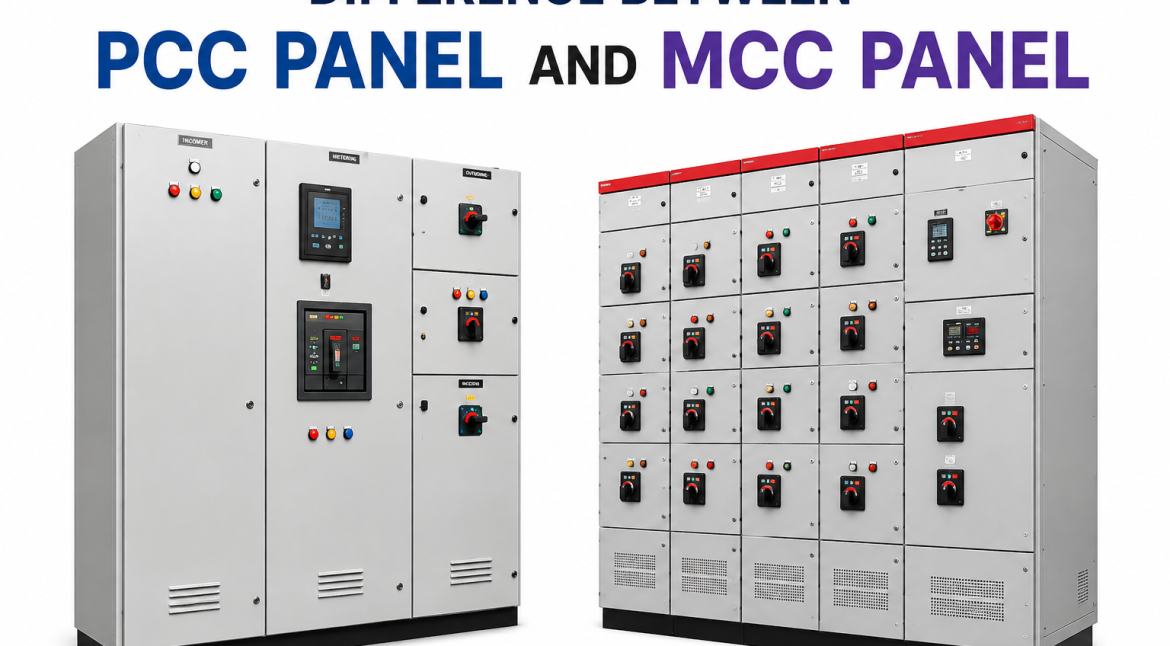
In every industrial and commercial electrical system, control panels play a critical role in ensuring safe and efficient power distribution. Among the most commonly used electrical panels are Power Control Center (PCC) Panels and Motor Control Center (MCC) Panels. Although both panels are essential for electrical operations, they serve different purposes and are designed for specific applications. Understanding the difference between PCC Panel and MCC Panel helps businesses select the right solution for improved safety, operational efficiency, and equipment reliability. In this blog, we explain their functions, key differences, applications, and how to choose the right panel for your facility.
What Is a PCC Panel?
A Power Control Center (PCC) Panel is the primary electrical distribution panel that receives power directly from transformers or generators and distributes it to various sections of a building or industrial plant. It acts as the main control hub for managing electrical power across the facility. PCC panels are equipped with circuit breakers, busbars, protective relays, metering devices, and monitoring systems that ensure reliable power distribution while protecting the electrical network from faults such as overloads and short circuits. These panels are commonly installed in manufacturing plants, commercial buildings, hospitals, and infrastructure projects where stable power management is essential.
What Is an MCC Panel?
A Motor Control Center (MCC) Panel is specifically designed to control and protect electric motors used in industrial processes. Instead of distributing power throughout an entire facility, an MCC panel focuses on managing motor operations such as starting, stopping, speed control, and overload protection. These panels typically contain motor starters, contactors, overload relays, variable frequency drives (VFDs), soft starters, and protective devices. MCC panels are widely used in industries where multiple motors operate simultaneously, including water treatment plants, manufacturing facilities, HVAC systems, food processing units, and chemical industries.
Key Difference Between PCC Panel and MCC Panel
The primary difference lies in their purpose. A PCC panel is responsible for receiving and distributing electrical power across different electrical loads, whereas an MCC panel is dedicated to controlling electric motors and ensuring their safe operation. PCC panels handle high-capacity incoming power and distribute it to distribution boards, MCC panels, and other equipment. In contrast, MCC panels receive power from PCC panels and manage individual motor circuits with advanced protection and control features. While PCC panels focus on overall power management, MCC panels focus on motor performance, efficiency, and operational safety.
Components Used in PCC and MCC Panels
Although both panels share some common electrical components, their internal configurations differ significantly. PCC panels generally include Air Circuit Breakers (ACBs), Molded Case Circuit Breakers (MCCBs), busbars, protective relays, energy meters, and monitoring instruments. These components help distribute electrical power safely across the facility. MCC panels, on the other hand, include motor starters, contactors, overload relays, timers, VFDs, soft starters, selector switches, and control wiring. These components are specifically designed to manage motor operations while protecting motors from electrical faults and mechanical stress. The design of MCC panels allows operators to monitor and control multiple motors from a centralized location.
Applications of PCC Panels
PCC panels are used wherever centralized electrical power distribution is required. They are commonly installed in manufacturing industries, commercial complexes, hospitals, airports, data centers, power plants, educational institutions, and large infrastructure projects. Their primary objective is to ensure continuous power supply while minimizing electrical failures. Modern PCC panels also support automation, remote monitoring, and energy management systems, making them suitable for smart industrial facilities.
Applications of MCC Panels
MCC panels are ideal for industries that rely heavily on electric motors. They are extensively used in water treatment plants, textile industries, pharmaceutical units, oil and gas facilities, food processing plants, HVAC systems, mining operations, and packaging industries. Since these industries operate multiple motors continuously, MCC panels help simplify motor control, improve maintenance, reduce downtime, and enhance operational efficiency. Advanced MCC panels integrated with PLC and SCADA systems also enable automated motor control and real-time monitoring.
Advantages of PCC Panels and MCC Panels
PCC panels provide several benefits, including efficient power distribution, enhanced electrical safety, improved load management, and easier maintenance. They also help reduce downtime by offering reliable fault protection and centralized monitoring of electrical systems. MCC panels offer advantages such as efficient motor control, overload protection, reduced energy consumption, simplified troubleshooting, and longer motor life. By integrating technologies like Variable Frequency Drives (VFDs), MCC panels can significantly improve energy efficiency while optimizing motor performance for different industrial processes.
How to Choose Between a PCC Panel and an MCC Panel
Choosing the right panel depends entirely on your operational requirements. If your objective is to distribute electrical power safely across an entire facility, a PCC panel is the appropriate choice. However, if your application involves controlling multiple electric motors with protection and automation features, an MCC panel is the better solution. In many industrial environments, both panels are installed together, with the PCC panel supplying power to the MCC panel, which then controls individual motor loads. Consulting an experienced electrical panel manufacturer ensures that the panel design matches your load capacity, safety standards, and future expansion needs.
Conclusion
Understanding the difference between a PCC panel and an MCC panel is essential for designing an efficient electrical distribution system. While PCC panels manage and distribute electrical power throughout a facility, MCC panels are responsible for controlling and protecting electric motors. Both panels perform unique yet complementary functions and are indispensable in modern industrial operations. Selecting the right panel improves system reliability, enhances safety, reduces maintenance costs, and increases overall operational efficiency. Whether you are planning a new industrial installation or upgrading an existing electrical system, investing in high-quality PCC and MCC panels ensures long-term performance and dependable power management.